












THE CAUCASUS:
AZERBAIJAN, GEORGIA AND ARMENIA
(itinerary subject to minor changes)
(itinerary subject to minor changes)
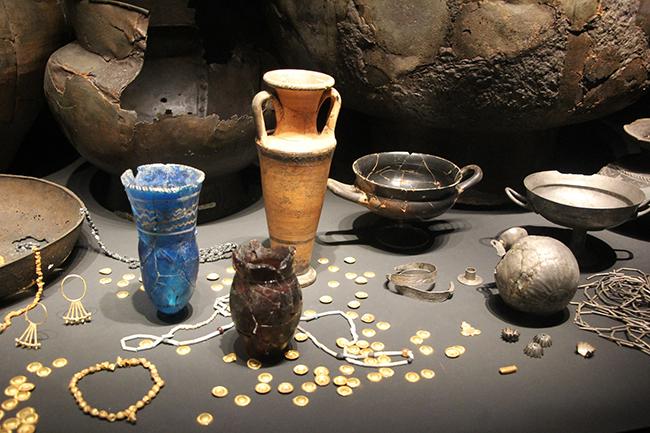
Vani treasures
Further in the distance
a massive amphitheatre of mountains
grows ever bluer and mistier...
What a delight to live in a place like this!
A feeling of elation flows in all my veins.
The air is pure and fresh like the kiss of a child,
the sun is bright and the sky blue
- what more could one desire?
Lermontov, A Hero of our Time
a massive amphitheatre of mountains
grows ever bluer and mistier...
What a delight to live in a place like this!
A feeling of elation flows in all my veins.
The air is pure and fresh like the kiss of a child,
the sun is bright and the sky blue
- what more could one desire?
Lermontov, A Hero of our Time
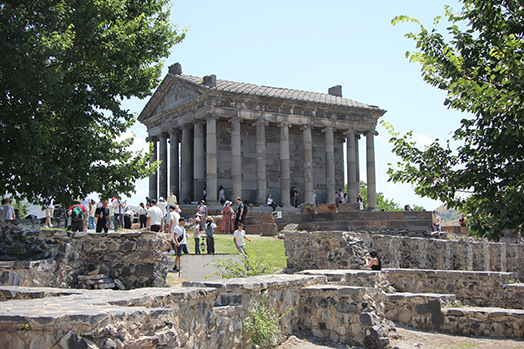
The temple of Garni
THE TOUR
This three-week tour explores the archaeology and history of the South Caucasus republics Azerbaijan, Georgia and Armenia. We begin in Baku, the capital of Azerbaijan, with a visit to the old quarter (Icheri Sheher) and a visit to Gobustan, a remarkable area of thermal pools and ancient petroglyphs. In Baku we also visit the National Museum to see the archaeological finds and visit the Green Markets. A day excursion also takes us to Ateshgah, a Zoroastrian fire temple in an area of burning gas vents.
We then head North West of Baku towards Sheki, stopping en route to see a 15th Century Maussoleum. In Shamaki we visit the historic Juma Mosque and visit the ancient village of Lagich. We continue to Sheki, a beautiful medieval town in the mountains. Here we visit the Sheki Bazaar, see the Palace of the Sheki Khans and the caravanserai.
We then cross the border into Georgia, passing through a scenic wine producing area and stay at a winery. We explore some of the Kakheti region and take a walk in the historic town of Telavi. The following day we explore the 18th Century royal town of Sighnaghi which is surrounded by defensive towers. We also visit the Bodbe Convent before heading to the Georgian capital Tbilisi.
The following day we examine the history of Tbilisi. We visit the 12th Century Metekhi Church and see the spectacular Narikala fortress which has wonderful views over the city. We walk through the old quarter of Tbilisi to see the Sulphur Baths and Sioni Cathedral. In the afternoon we visit the National Museum of Georgia which houses key artefacts from the region.
We then have a day excursion south of Tbilisi, to Dmanisi, to explore the early hominid Archaeological site. We also see the nearby medieval town, fortress and cathedral. The following day we head north to see the 6th Century Jvari Monastery and the old city of Mtskheta where we visit an 11th Century cathedral. We drive up into the Caucasus to see stunning mountain scenery and stay overnight in Gudauri.
The following day we head south to explore the Ananuri Monastic Complex dated to the 16th and 17th Century complex. We also see Hellenistic and Christian remains of the rock-hewn town of Uplistsikhe. Later, in the afternoon, we see the ancient Gori fortress. We stay in Kutaisi and the next day visit the archaeological remains of Vani. This Hellenistic period temple town of ancient Colchis is famous for its superb gold treasures. We also see the Vardzia Cave Monastery dating to the 12th Century.
The following day we cross into Armenia. We visit the 10th-13th Century Haghpat Monastery and then visit Lake Sevan where we see Sevanavank Monastery. Yerevan, the capital of Armenia, will be our next destination and will act as a base for exploring southern Armenia. We start by exploring the rich archaeological remains in the city including the Bronze Age Shengavit settlement, and the Iron Age Uratrian fortress of Erebuni. We also see the artefacts in the History Museum.
The next day we see the key historic monuments of Yerevan including the Etchmiadzin Cathedral, and the Armenia Genocide Memorial, and we take a walk through the city. We then have a day excursion to the Khor Virap and Noravank monastic quarters, before finishing our day at the Areni cave Complex with remains of early wine production.
Our tour concludes with a day excursion south of Yerevan. We see the spectacular Garni Roman temple and the nearby gorge. Our final visit is the Monastic Complex of Geghard which includes several churches. A walk back in the Yerevan quarter of Kond provides a final opportunity for shopping.
ITINERARY*
Day 1: Arrive BakuYou arrive in Baku, the capital of Azerbaijan. We will meet at 7pm in the lobby of the hotel to go out for dinner. Overnight Baku.
Day 2: Baku - Gobustan
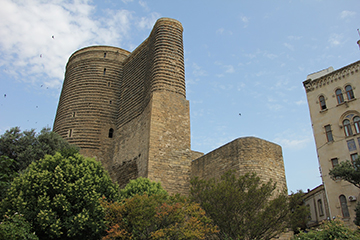
This morning, we explore some of the historic sites of Baku. We start in Martyrs Lane which has a great view of Baku's coastline. In Icheri Sheher, the old part of the city, we visit the Shirvanshah's Palace and the 12th Century Maiden Tower. We also see the Caravanserai and Museum of Miniature books and the main market square. After lunch, we drive to Gobustan to visit the Petroglyphs Museum and explore petroglyphs dating back to 10,000 BC. We also see hot mud pools. Overnight Baku.
 |
 |
Maiden tower in Baku |
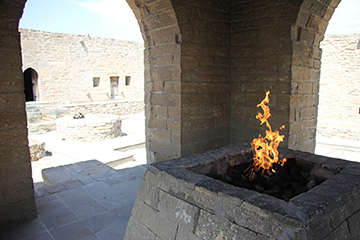
The fire temple at Ateshgah |
Day 3: Baku - Museum of Archaeology - Old City
The morning is set aside to visit the Museum of Archaeology. We see the extensive collection of artefacts from the Palaeolithic to medieval times. In the afternoon we have a walk in the Old Quarter of the town including a visit to the Green Markets where fresh fruit and vegetables are for sale. Overnight Baku.
Day 4: Baku - Ateshgah
Today we drive to the Absheron Peninsula to visit Ateshagh, a Zoroastrian fire temple dating from the 17th Century located in the village of Surakhany. We also see the Yanar Dag 'Burning Mountain', a natural gas fire on a hillside which has been burning for centuries. In the afternoon we return to Baku to visit the iconic Heydar Alyev Cultural Centre, which was designed by Iraqi-British architect Zaha Hadid. Overnight Baku.
Day 5: Shamakhi - Lagich - Sheki
This morning, we leave Baku and head north west towards Sheki. On the way, we stop at the 15th Century Diri Baba Mausoleum in Maraza village. We then continue to Shamakhi to visit the historic Juma Mosque, which was restored in 2013. We take a scenic drive through the Girdimanchay River Canyon to the 5th Century village of Lagich, an historic centre with cobbled streets. Lagich is famous for its many traditional workshops (jewellery, copperware, carpets, pottery, daggers, and iron tools). We continue to Sheki, a beautiful medieval town set in a lush mountainous area, famous for its baklava. Overnight Sheki.
 |
 |
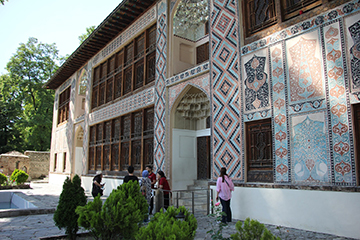
Khan's Palace in Sheki |
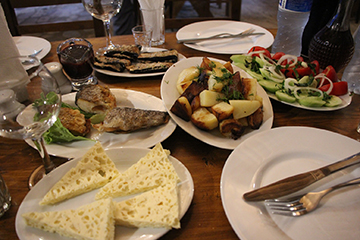
Sampling Georgian food and wine |
Day 6: Sheki - Georgian border - Kakheti
After breakfast we visit the colourful Sheki Bazaar which sells local fruits and berries, spices, freshly-baked bread, honey, cheeses, and Sheki sweets. We continue to the Palace of the Sheki Khans, a complex surrounded by medieval fortress walls. We visit handicrafts workshops and a caravanserai. We then leave Sheki and cross the border into Georgia (115km - 2 hours). We pass through scenic landscapes including vineyards and wine-producing villages. In the afternoon we tour a family-owned winery. We stay at Schuchmann Wines Chateau which is surrounded by vineyards and offers stunning views of the Caucasus Mountains. Overnight Schuchmann winery.
Day 7: Telavi
We journey to Telavi, the capital of the Kakheti region. We visit the Royal Castle History Museum known as the "Batonistsikhe" built in the 17th Century. We explore the making of Qvevri, the amphora-shape clay vessels used to produce wine in Georgia. We then taste locally produced wine and cheeses, and walk in the old quarter of Telavi. Overnight Schuchmann winery.
Day 8: Tsinandali - Sighnaghi - Bodbe
In the morning, we visit the Tsinandali Estate, the old residence of the dukes of Georgia. It has a beautiful museum, and a wine cellar that belonged to Prince Chavchavadze, a poet of the 19th Century. We have lunch with a local family. We then drive to the royal town of Sighnaghi, which is surrounded by defensive walls with 23 towers - this was an important point on the Silk Road. We also visit the Bodbe Convent - according to legend, this is the burial place of St Nino, who converted Georgia to Christianity in the 4th Century. Overnight Tbilisi.
 |
 |
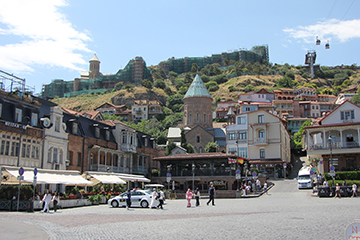
Narikala fortress |
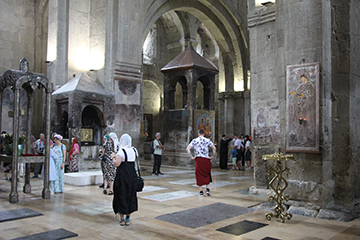
Svetitskhoveli cathedral |
Day 9: Tbilisi
The day is spent exploring the history of Tbilisi. We visit the 12th Century Metekhi Church and the nearby monument to Vakhtang Gorgasali, the legendary founder of Tbilisi. We explore the spectacular Narikala Fortress which has panoramic views of the city. We then walk down to the Sulphur Baths and have a stroll through the Shardani area where we visit the 5th-7th Century Sioni Cathedral. After lunch we visit the National Museum of Georgia which houses the treasures from Akhalgori and Vani as well as Homo georgicus fossils from Dmanisi. Overnight Tbilisi.
Day 10: Dmanisi
In the morning, we take a day excursion to the Dmanisi Hominid Archaeological site, about 85km SW of Tbilisi. We explore the open-air museum where the 1.8 million year old hominin remains were found. We also see the ruins of the medieval town, the Dmanisi fortress and the 6th Century Dmanisi Sioni Cathedral. Overnight Tbilisi.
Day 11: Jvari - Mtskheta
Today we explore some of northern Georgia. We start with Jvari Monastery, a masterpiece of the 6th Century - it is perched on a hill above the confluence of the Aragvi and Mtkvari Rivers. We continue to Mtskheta, one of the early capitals of Georgia (then called the Kingdom of Iberia). In the town we visit the 11th Century Svetitskhoveli cathedral. In the afternoon we drive over the Cross Pass and make a short stop at the Soviet-era "People's Friendship" mountain viewpoint, which overlooks a deep gorge of the Caucasus Mountains. Overnight Gudauri.
Day 12: Ananuri - Uplistsikhe - Gori
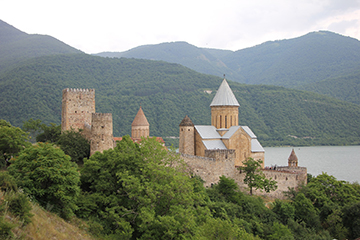
This morning, we see the Ananauri Complex, a former residence of Argveti dukes, with churches and towers dating back to the 16th and 17th centuries - it has beautiful views over the Jinvali Reservoir. We then explore the rock-hewn town of Uplistsikhe, which dates from the Hellenistic Period combining both pagan and Christian structures. In the afternoon we stop to see the Gori Fortress (first built in the 7th Century AD) and then drive to Kutaisi. Overnight Kutaisi.
 |
 |
Ananauri |
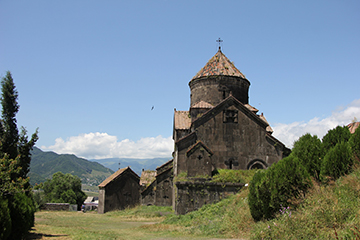
Haghpat Monastery |
Day 13: Vani - Vardzia
Today we visit the Vani Archaeological Reserve, site of an ancient temple city of the Kingdom of Colchis (flourished from the 8th to 1st Century BC). The museum houses superb gold artefacts and bronze statues discovered during the Vani excavations. In the afternoon we stop at the Vardzia Cave Monastery, a vast rock-cut complex built in the reign of the 12th Century Queen Tamar. Overnight Tbilisi.
Day 14: Armenian border - Haghpat - Lake Sevan - Sevanavank
In the morning, we transfer to the Georgian-Armenian border point at Sadakhlo-Bagratashen. We cross the border and drive to the Haghpat Monastery. This stunning example of Armenian architecture, erected between the 10th and 13th Centuries, overlooks the Debed River Canyon. We continue to Lake Sevan located at 1900m above sea level. The lake's coastline is rich with dense woods, white cliff faces, mountain steppes, and Alpine meadows. We visit Sevanavank Monastery, on the shore of the Lake. In the afternoon we head to Yerevan the capital of Armenia. Overnight Yerevan.
Day 15: Yerevan
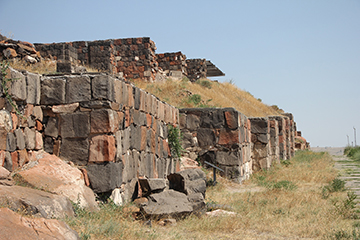
In the morning, we visit the Shengavit Settlement, a Bronze Age settlement located within the city limits - we see the remains of houses and site museum. We then visit the History Museum of Armenia in Republic Square. This houses the most significant artefacts from the country including finds from the Areni-1 Cave and Metsamor. In the afternoon we visit the Erebuni Urartian Fortress and Archaeology Museum. The fortress was built in 782 BC and the museum contains cuneiform inscriptions and artefacts. Overnight Yerevan.
 |
 |
Erebuni Urartian fortress |
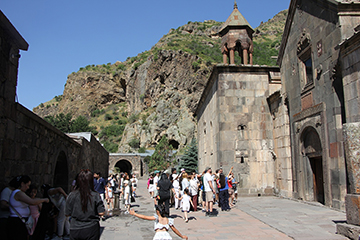
Geghard Monastery |
Day 16: Yerevan
After breakfast, we visit the Holy See of Armenia and the Etchmiadzin Cathedral (the residence of the Catholicos, the supreme head of the Armenian Apostolic Church) and see the museum of Christian relics. We then visit the Armenian Genocide Memorial and museum on Tsitsernakaberd Hill. Next, we see the Cascade Monument, a 500m high limestone staircase. From the top of the monument, there is a breathtaking city view that includes the Opera House, and Mt Ararat (in Turkey). We lastly take a walk though the heart of the city. Overnight Yerevan.
Day 17: Khor Virap - Noravank - Areni Cave
This morning, we head to Khor Virap Monastery. According to legend, St Gregory the Illuminator (credited with converting Armenia to Christianity) was here for 13 years for disseminating Christianity, until King Tirdat decided to adopt the new religion. The monastery has superb views of Mount Ararat in nearby Turkey. We then drive to the Noravank complex, which is situated overlooking a deep gorge. We finish the day by visiting the Areni Cave Complex where ancient wine storage facilities were discovered. Overnight Yerevan.
Day 18: Garni - Symphony of Stones - Geghard
Today we drive south of Yerevan to Garni, site of an important Roman era pagan temple which survived the introduction of Christianity in the 4th Century. We descend Garni Gorge to explore monumental rock formations known as the Symphony of Stones. Our final sightseeing stop is the monastery complex at Geghard. The complex consists of several churches and tombs representing Armenian medieval architecture at its finest. Back in Yerevan we take a stroll around Kond, the oldest district in the city with opportunities for last minute shopping. In the evening there is a farewell dinner at one of the local restaurants. Overnight Yerevan.
Day 19: Departure from Yerevan
Today we depart from Yerevan.
* Please note that the Company reserves the right to make alterations to the itinerary in the period up to 60 days prior to a tour departure. The itinerary may also be subject to minor re-arrangement due to the scheduling of the operators and availability of access. If this occurs, the Company will endeavour to provide a comparable alternative.