












ANCIENT ALGERIA:
ARCHAEOLOGY AND THE DESERT
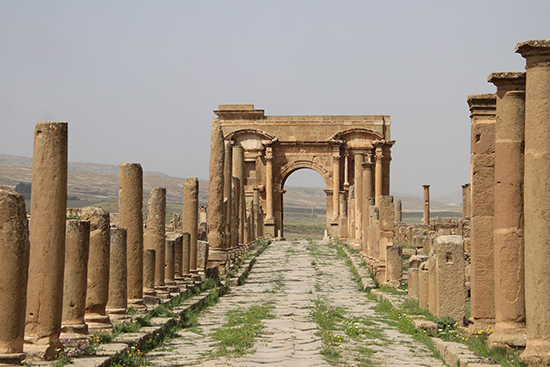
The decumanus of Timgad
'Once already I had returned to Tipasa, soon after those war years that marked for me the end of youth. I hoped, I think, to recapture there a freedom I could not forget. In that spot, indeed, more than twenty years ago, I had spent whole mornings wandering among the ruins, breathing in the wormwood, warming myself against the stones, discovering little roses, soon plucked of their petals, which outlive the spring. Only at noon, at the hour when the cicadas themselves fell silent as if overcome, I would flee the greedy glare of an all-consuming light. Sometimes at night I would sleep open-eyed under a sky dripping with stars. I was alive. Fifteen years later I found my ruins, a few feet from the first waves, I followed the streets of the forgotten walled city through fields covered with bitter trees, and on the slopes overlooking the hay I still caressed the bread-colored columns ... On the promontory that I used to love, among the wet columns of the ruined temple, I seemed to be walking behind someone whose steps I could still hear on the stone slabs and mosaics but whom I should never again overtake ...'
'Return to Tipasa', by Albert Camus
'Return to Tipasa', by Albert Camus
THE TOUR
This tour explores the wonderful Roman ruins and stunning desert landscapes of Algeria. The tour starts in the capital Algiers where we see the ancient medina, visiting two restored Ottman houses and the port area where we explore the Palace of the Admirals. Later in the day we visit the National Archaeological Museum which has a remarkable collection of Roman mosaics and statues from key sites around the country.
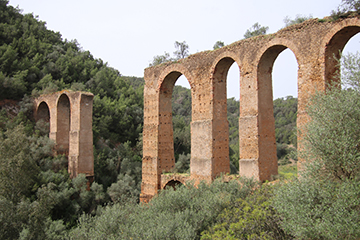
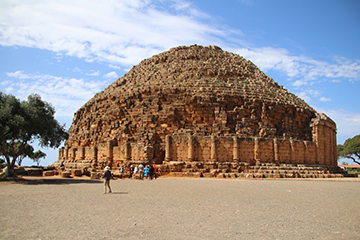
The next day we head west to Cherchell, site of the ancient city of Iol-Caesarea. This was the capital of Numidian King Juba II and his wife Cleopatra Selene. Together over 40 years they created a stunning Hellenistic style city with theatre, aqueduct and protected port. In the afternoon we stop to see the enormous Mauretania tomb where Juba and Cleopatra are thought to have been buried.
We next fly down to the town of Djanet in southern Algeria. This will be our base for two days exploring the stunning desert landscapes and ancient rock art of the Tassili N'Ajjer National Park. Each day we head north by 4-wheel drive to see desert landscapes, the open dunes, and numerous rock shelters decorated with elephants, giraffe and tribesmen. In the evening, we return to our hotel in Djanet for a good night sleep.
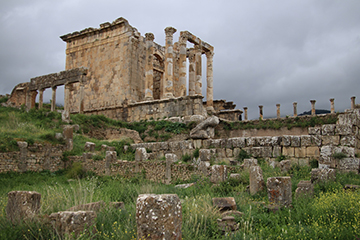
We return to Algiers and then head east to begin our exploration of the remarkable Roman ruins in the area. Our first stop is the superb Roman city of Cuicul, better known today using the Arabic term Djemila, meaning 'The Beautiful'. Cuicul prospered in the First and Second Century AD and acquired the attributes of major Roman centre including a theatre, two impressive temples dedicated to Jupiter and Venus, impressive wealthy houses with floor mosaics, and an enormous bath complex. The site museum preserves the best mosaics.
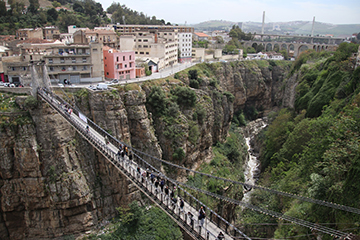
We continue our journey to Constantine which will be our base for a few days. We explore this stunning city perched on an enormous cavern descending through the mountains. We visit the town museum which has lovely Roman statuary, and then see the well preserved Palace of the Ottoman governor of the region. In the afternoon there is time to explore the gorge by bus with short walks to viewing places. Our tour next includes a day excursion north of Constantine to see the hill-top settlement of Tiddis. This was a Roman military outpost with excellent views over the fertile landscapes. We see a number of arches, impressive houses, a small forum, and a temple to the god Mithras. We return to Constantine for some free time in the afternoon.
The following day we leave Constantine, heading NE through very scenic rural country. We stop to see the ruined Tomb of El Khroub then visit the Roman ruins of Thibilis. This scenic settlement was a small farming community with its own forum, numerous houses and town arches. We then continue to Guelma where we briefly see the restored Froman theatre before heading on to Annaba.
We explore the town of Annaba, an ancient Roman city known as Hippo Regius. This was a major port on the Mediterranean coast and prospered as a result. Numerous houses were built around the town forum, and in Christian times an enormous basilica was built where Saint Augustine preached. The site museum has lovely mosaics. We then head south of Annaba, stopping at two provincial Roman towns: Thubursicu and Madauros. These towns prospered in the 2nd Century AD and developed grand civic buildings. An enormous Byzantine fortress was built in the 6th Century AD at Madauros and it is very well preserved.
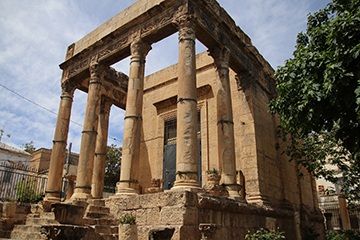
In the Roman town of Theveste, now called Tebessa (where we stay for one night), there are some astonishing remains from the Roman period. These include the almost intact Temple of Minerva, the Gate of Caracalla, the amphitheatre of the town, the almost intact Byzantine walls and watch towers of the city, and the enormous early Christian Church Complex of St Crispina.
In the afternoon we drive across the broad fields to Timgad, ancient Thamugadi. Timgad is without doubt one of the most impressive ancient Roman cities in the world. Spread over a wide area, the urban remains have been extensively excavated and include an enormous Capitoline temple, a grand forum with Temple of Victory, a theatre complex, numerous baths, street arches and impressive 2nd Century houses. We spend a day walking this amazing place.
The following day we see the ruins of Lambaesis where the Third Legion Augusta guarded the frontiers of settled Roman life. We see the still grand amphitheatre, the legionary encampment, and part of the nearby township. On the way back to Constantine we stop to see the Medracen Tomb used by the Numidian ruler of the 3rd Century BC. We next head to Setif where we visit the town museum - it contains some stunning mosaics including the remarkable Triumph of Dionysus. We head to Algiers airport and fly down to the Ghardaia oasis. Here we explore some of the desert valley including two of its fortified villages.
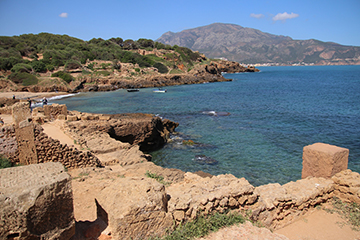
We return to Algiers for the end of the tour. Here we explore the Bardo Palace, an Ottoman residence with lovely, restored interiors. We also see the lovely Algiers Botanical Gardens, laid out by the French in the early 19th Century. We also visit the nearby Martyrs Monument which commemorated those who died repulsing the French in the 1960s. Our final visit of the tour is a day excursion to the appealing Roman site of Tipasa. An important commercial centre on the Mediterranean coast, Tipasa developed a grand forum, theatre and temples, as well as a large Christian Quarter with basilicas. This lovely place will long remain in your memory, as it did for author Albert Camus.
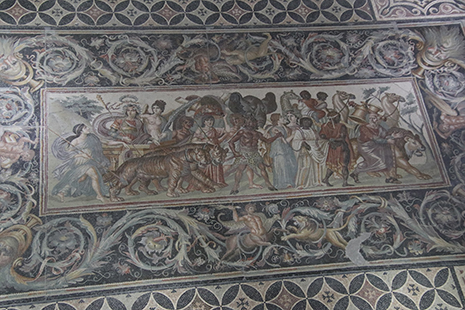
Mosaic of the Triumph of Dionysus from Setif
ITINERARY*
Day 1: Arrive in AlgiersYou should arrive in Algiers. Overnight Algiers.
Day 2: Algiers
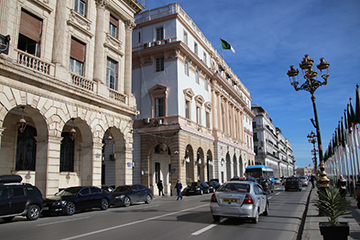
In the morning, we explore the historic heart of Algiers. We see two restored houses in the ancient medina (known as the khazbah) and visit the Ottoman fortress of the Admiral. In the afternoon we see the National Archaeological Museum which contains unique sculptures and mosaics from various sites. Overnight Algiers.
 |
 |
The waterfront at Algiers |
The aqueduct at Caesarea |
Day 3: Cherchell - Mauretanian tomb
Today we visit Cherchell, the ancient site of Caesarea, which lies west of Algiers. This was the capital city of Juba II and his wife Cleopatra Selene. We see the wonderful site museum and also explore the well preserved aqueduct, before stopping to see the enormous Mauretanian Royal Tomb. In the evening we fly to Djanet. Overnight Djanet.
Day 4: Djanet
The day excursion from Djanet takes us north of the city to explore stunning desert landscapes and rock art. Overnight Djanet.
Day 5: Djanet
The day excursion from Djanet takes us north of the city to explore stunning desert landscapes and rock art. We fly back to Algiers in the afternoon. Overnight Algiers.
 |
 |
The Mauretanian tomb |
Rock art near Djanet |
Day 6: Djemila
In the morning, we leave Algiers and drive east to Djemila - here we explore the extensive Roman ruins of the ancient city of Cuicul. These include a grand Capitolium, a theatre, bath complexes and numerous houses. We visit the site museum which has impressive mosaics from the site. Overnight Constantine.
Day 7: Constantine
Today we explore the history of the remarkable city of Constantine. In the morning, we see the lovely antiquities in the Archaeology Museum. We then visit the impressive 19th Century Ottoman palace of the Bey of Constantine. In the afternoon we drive around the edge of the gorge of Constantine, stopping to see the stunning views. Overnight Constantine.
Day 8: Tiddis
Today we have a day excursion north of Constantine to see the Roman ruins of Tiddis. This military base located on a small hill has well preserved houses and a Mithraeum. In the afternoon there is some free time. Overnight Constantine.
 |
 |
The Capitolium of Djemila |
The gorge at Constantine |
Day 9: Le Khroub - Thibilis - Guelma
We leave Constantine, stopping to see the Le Khroub Numidian tomb. We then head to the ancient ruins of Thibilis (modern Announa). The ruins of this small ancient Roman town include a well preserved forum area and houses. After lunch in Guelma, where we see the heavily reconstructed Roman theatre, we continue to Annaba on the coast. Overnight Annaba.
Day 10: Hippo Regius
Today we visit the extensive ruins of Annaba, the ancient city of Hippo Regius. These ruins include a well preserved forum, houses and an important early Christian basilica. The local museum has arterfacts from the site. In the afternoon we take a drive along the Mediterranean coast to see the rocky scenery. Overnight Annaba.
Day 11: Thubursicu - Madure
Today we head south of Annaba, stopping to see the ruins of the ancient site of Thubursicu Numidarum (modern Khamissa). The ruins include a theatre, grand forum and bath complex. We then continue to visit the ruins of Madaure. This site has a well-preserved Byzantine fortress which incorporates the ancient Roman forum of the town. Overnight Tebessa.
 |
 |
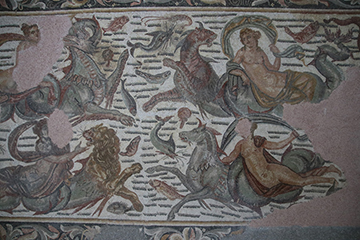
Mosaic from Annaba |
Temple of Minerva at Tebessa |
Day 12: Tebessa
In the morning, we see the remarkable ancient remains of Tebssa (ancient Theveste). These include the arch of Caracalla, later incorporated into the Byzantine walls, and the almost perfectly preserved Temple of Minerva. We also see the impressive Church of St Crispina. In the afternoon we drive to Timgad. Overnight Timgad.
Day 13: Timgad
The day is set aside to explore the extensive ruins of the ancient Roman city of Timgad. This impressive site includes numerous bath houses, ancient Roman houses, a well-preserved forum with Temple of Victory, and a Capitoline Temple. The site museum contains numerous splendid mosaics from the site. Overnight Timgad.
Day 14: Lambaesis - Medracen tomb
In the morning, we leave Timgad and see the Roman ruins of Lambaesis near modern Tazoult. We visit the small site museum and then explore the remains of the amphitheatre and Roman legionary camp. In the afternoon we head back to Constantine, stopping to see the impressive Numidian Medracen tomb. Overnight Constantine.
 |
 |
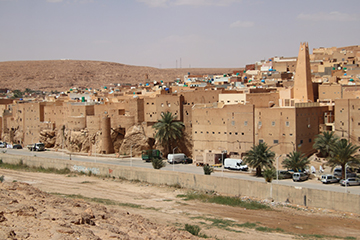
The ancient walled cities of Ghardaia |
Ancient Tipasa |
Day 15: Sitifis
Today we drive from Constantine back to Algiers, stopping on the way to see the museum and ancient remains of the Roman settlement of Sitifis (modern Setif). This includes an impressive mosaic of the Triumph of Dionysus and artefacts from the local area. We drive to Algiers airport for our flight to Ghardaia. Overnight Ghardaia.
Day 16: Ghardaia
Today we visit two of the medieval settlements in the Ghardaia Oasis. We start with Ghardaia city which includes traditional houses, covered streets and a busy market. In the afternoon we explore the walled city of El Atteuf and climb to the top of the ancient watch tower. Overnight Ghardaia.
Day 17: Algiers
In the morning, we fly back to Algiers. After lunch we visit the beautiful Ottoman era Bardo palace which has lovely restored rooms and courtyard. The house contains artefacts from the Palaeolithic era. We have a walk in the botanical gardens of Algiers, used to film the original Tarzan, and see the Martyrs Monument overlooking the city. Overnight Algiers.
Day 18: Tipasa
Today we explore the beautiful Roman site of Tipasa which lies on the Mediterranean shore near Algiers. The site includes a beautiful 1st Century forum, theatre and many grand Roman houses. There is also the ruins of an impressive Christian basilica. Overnight Algiers.
Day 19: Depart from Algiers
Departure from Algiers.
* Please note that the Company reserves the right to make alterations to the itinerary in the period up to 60 days prior to a tour departure. The itinerary may also be subject to minor re-arrangement due to the scheduling of the operators and availability of access. If this occurs, the Company will endeavour to provide a comparable alternative.